
In the 1950’s Harold Osborne (Chief Engineer: American Telephone & Telegraph Company) predicted that mobile telephony would eventually allow us access to whomever, whenever, by entering a combination of numbers into a small portable device.
Osborne correctly thought that these devices would allow us to hear and see people three-dimensionally. At the time this would have been a bold statement to make. However fifty-six years on, even he couldn’t have predicted the present technology (Conly) and what it is being used for.
“The technological innovations of mobile telephony were established from the 1940s” (Lacohée). Branded mobile telephones have been around for just over 30 years and their technology is rapidly advancing.
Due to their relative affordability and accessibility, mobiles are penetrating the entire globe “with many developed countries reaching 60% ownership rates” (Goode) whereas “prior to 1985, no one in Britain had a mobile telephone” (Lacohée).
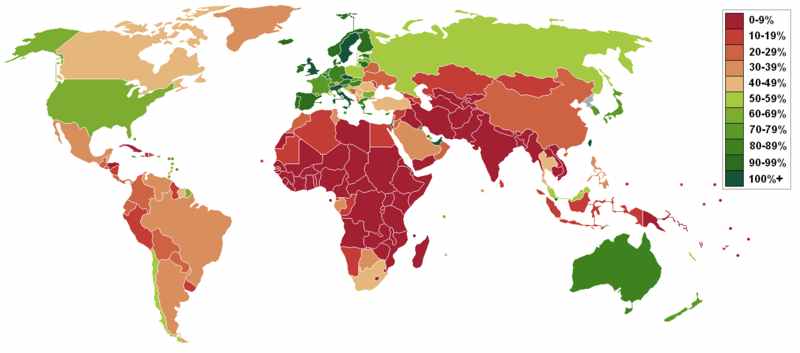
(World mobile phone usage map 2008 – Source: solarnavigator.net)
Since Cooper made the first mobile telephone call in 1973 the mobile telephone has become as innate and equivalent “to sipping a cup of coffee or taking a cigarette break. It is a street level device packaged and mobilized in the status displays of everyday life” (Ito).
However the mobile is no longer an “empowering piece of technology, putting communicative power into the hands of the individual” (Geser) or solely being used so that X can get hold of Y and Z, or so that the masses can communicate. Now mobile phones are rapidly becoming a tool of the B2B marketer with massive opportunity to target businesses directly.
Businesses already contact consumers via mobile telephones and “up to now they have been seen as very much a consumer marketing channel” according to Dacombe, Verridians marketing director.
However businesses are already contacting one another via mobiles when they are not in the office or communicating face-to-face. This suggests that the use of mobiles as methods of B2B marketing communications is inevitable especially if you look at the history of digital communication and consumption of new technology which ultimately leads to its mass and innate use.
According to MediaPost Online Media Daily (2010) 54% of the Fortune 100 companies are planning to increase spending on email marketing and 66% planned to increase expenditures for social media “even though about 80% of those acknowledged the difficulty in tracking ROI in the medium”. Not only this but with “a recent survey of B2B marketers by LinkShare at AdTech revealing that 28% believe ads on social networks will be the most important form of B2B advertising in 2011” (Weekes) and with 80% of Twitter use being on mobile devices (Williams) the mobile telephone is becoming an ever more exciting prospect for B2B marketing.
As Toedman suggests “the digital space just offers up so many new ways to add value to your brand that it becomes so much more complex. But ultimately, more exciting too.” “In the next five to ten years the mobile will be the device that allows the retailer and the brand owner to influence shopper behavior” (Taylor).
A prime example of a B2B marketer being able to advertise because of digitalisation and via the mobile telephone is because of technology such as the Facebook app: Facebook Places. This is a voluntary application which is frequently accessed by mobiles allowing business to track where people are going and whom they are going with.
This type of technology allows B2B marketers to precisely communicate with other business providing them with the correct information and promotional material depending on their specific location. For example at tradeshows and other business events, through the location-based application, B2B marketers can provide real-time offers and discounts to those specifically in attendance.
This movement to mobile marketing could be suggested because of Smartphone’s rapid rise to a status symbol of normality (Dacombe), becoming more entrenched into all aspects of life for consumers and businesspeople alike. With younger and tech-savvy executives moving up the ranks, the mobile opportunities for B2B marketers are opening up (What do C-level Exec’s Really Think About Using Mobile?) and increasing in weirder ways than ever expected. How could the technology spoken about by Hemmert in the video below one day be used for B2B marketing? If at all?
Where and what is next for mobiles and B2B marketing? These are the questions I leave you with. And the statement I leave you with is: 2011 will be a busy time for mobiles as a B2B marketing platform.

The development of mobile technology is incredible, so much as been achieved in such a short space of time!
ReplyDeleteThe introduction of the Smartphone has created new possibilities for communication and with mobile applications such as foursquare, our social environment is becoming increasingly more digital, interactive and converged.
In my post on blogging (http://theriseofpr.blogspot.com), I asked - When does an innovation become an everyday business practice? I would certainly agree that Smartphones, with their wireless internet capabilities, have made mobile phones a key tool for the communications industry.